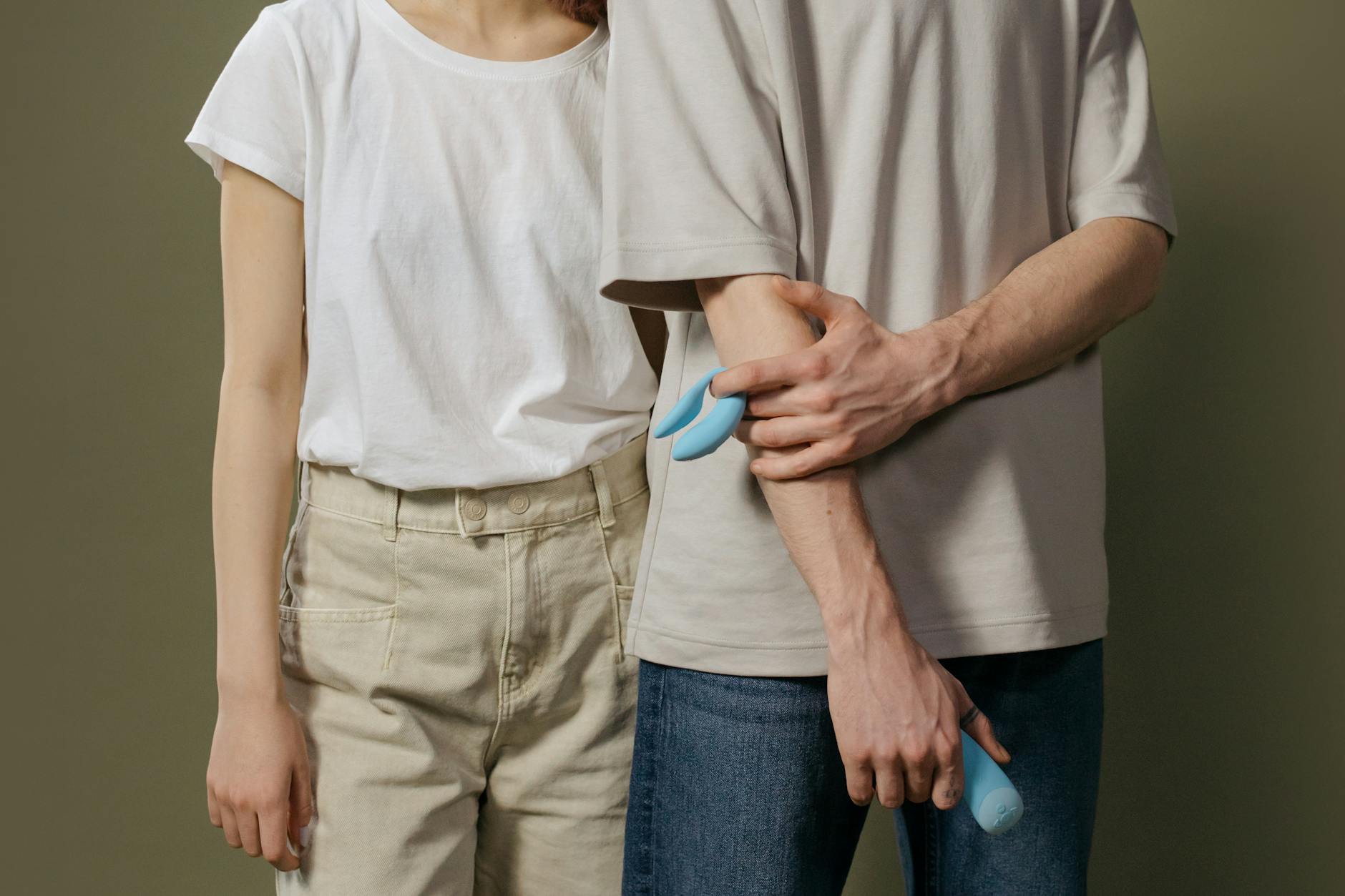
You're in bed. Your partner is there, or you're alone, or you're trying to be present with your own body. And there's this voice in your head. The one asking: "Is this taking too long? Am I supposed to be coming by now? Am I broken? Why isn't this working?" That voice is not you. It's anxiety. And it's shutting down every nerve ending that could actually feel good.
Anxiety about pleasure is wildly common. It shows up as pressure to orgasm, fear that your body is "taking too long," worry that you're not responsive enough, or a creeping sense that something is wrong with you. None of those things are true. But they're loud enough that they drown out sensation.
Here's where lemon vibrators actually become useful. Not because they're magic. Because they interrupt anxiety's stranglehold on your nervous system.
When you're anxious, your sympathetic nervous system (the fight-or-flight side) fires up. Your vagal tone drops. Blood vessels constrict. Your pelvic floor tightens defensively. Your brain stops processing pleasure signals and starts processing threat signals instead. You're not broken. You're literally in survival mode, even though nothing is actually dangerous.
This is why willpower doesn't work. You can't "relax" yourself out of this state through intention alone. You need a physiological redirect.
The best research on this comes from sex therapists and somatic practitioners, who've found that the fastest way to calm an anxious nervous system during sex is through strong, consistent sensory input that requires zero effort from you. Lemon clitoral vibrators, particularly the kind that use air-pulse technology, deliver exactly that.
Traditional vibration requires your brain to integrate a diffuse sensory signal across your clitoris. Your anxious brain can still interrupt that process. Air-pulse sensation is different. It's focused, rhythmic, and persistent in a way that's harder for anxiety to override. It's like the difference between trying to think about your worries while someone is tapping your shoulder randomly versus someone pressing firmly on a specific point. The firm, consistent pressure is harder to ignore.
Lemon clitoral vibrators that use suction or air-pulse technology create what therapists call a "sensory anchor." Instead of your brain trying to evaluate whether you're doing pleasure correctly, the vibration does the evaluating for you. Your job becomes passive. That passivity is what your anxious nervous system needs.
Here's something I've noticed after years of working with couples around pleasure: most anxiety about sex isn't really about sex. It's about permission. Permission to take up space, to have needs, to spend time on yourself, to potentially feel good without earning it first.
Using a lemon vibrator gives you an external permission structure. "I'm using a tool designed for this." "This is normal." "I don't have to figure it out myself." That might sound silly. But your nervous system doesn't care if the permission is rational. It cares that the signal is clear.
When you use a clitoral vibrator, your brain gets to relax the supervision. You're not responsible for creating sensation. The tool is. That shift from active generator to passive receiver is where anxiety loses its grip.
Anxiety often shows up as rushing. "Let me get this done so I can stop worrying about whether this is working." That speeds everything up, which makes it harder to actually feel, which confirms the anxiety that something is wrong.
Lemon vibrators have a different timeframe than manual stimulation. They're designed for longer sessions. The Lem, for example, works best in sustained patterns over 10-20 minutes, not short bursts. That extended timeline is actually healing for an anxious nervous system.
Why? Because it tells your brain: "This is not an emergency. We have time. There's no finish line we're racing toward." That permission to slow down is often the first shift that happens. And once your sympathetic nervous system realizes it's not under threat, pleasure becomes accessible again.
If you've tried a lemon clitoral vibrator and it didn't immediately work, that doesn't mean you're broken. It often means your nervous system is still in protection mode, and one session isn't enough to convince it otherwise.
Think of using a clitoral vibrator the way you'd think about going to therapy. The first session doesn't fix your anxiety. But it begins to teach your nervous system that something different is possible. Over time, with repetition, that new pattern becomes normal.
People who struggle most with pleasure anxiety often report that the Lem or a similar air-pulse lemon vibrator "clicks" somewhere around week two or three of regular use. Not because the tool changed. Because their nervous system finally believed it was safe to let pleasure in.
Sometimes pleasure anxiety points to something that needs actual professional support. Past trauma. A pattern of ignoring your own body's signals. Deep shame about desire. If you notice that a vibrator helps sometimes but you're still in a cycle of pressure and shutdown, talking to a therapist trained in sex therapy or somatic work can transform the foundation, not just the symptom.
Lemon vibrators are tools. Good ones. But they work best when paired with actual permission, communication (if you have a partner), and sometimes professional support. That's not a failure. That's just being honest about how nervous systems actually change.
If you have a partner, lemon vibrators can actually ease performance anxiety in the relationship too. Instead of sex becoming a thing you're both anxiously waiting to "work," it becomes collaborative and tool-supported. One partner can use the vibrator while the other is present in other ways. The focus shifts from "are we doing this right" to "what feels good to both of us."
You can even explore this together. Some people find that watching a partner use a clitoral vibrator, or vice versa, actually decreases performance pressure because the goal is explicitly about sensation, not about proving something. That shift in frame is sometimes enough to let both people relax.
Most people notice a shift in the first few sessions, but the real change happens over 2-4 weeks of regular use. Your nervous system is relearning that it's safe to feel. That takes repetition. Patience with yourself here is not weakness. It's part of the process.
Sometimes, if you're using it while still in pressure mode. If you're expecting it to "fix" you or using it as another way to perform, it can actually deepen anxiety. The tool works best when paired with genuine permission and a slower pace than you think you need.
Air-pulse lemon vibrators tend to work better for anxious nervous systems than traditional vibration because the sensation is more focused and harder for your brain to ignore. But the best vibrator is always the one that feels good to you. Start with that.
You might have been using a different type, or using it in a pressured way. Air-pulse lemon clitoral vibrators like the Lem are specifically designed to calm rather than stimulate aggressively. The goal is gentler, more sustained sensation, not intensity.
Both work. Some people find that starting alone helps them build trust with sensation without the added pressure of someone else's presence. Others find partner presence genuinely grounding. Try what feels right. This is about your comfort, not about what's "supposed" to happen.
Breathing, honestly. And permission statements if that helps. "My body is safe." "This is for me." "There's no deadline." Some people benefit from a longer warm-up before introducing the vibrator. Others find that dimmed lighting or familiar music helps their nervous system settle. Experiment and listen to what your body actually needs.
Anxiety about pleasure is not a character flaw. It's a nervous system that learned to protect itself by staying vigilant. That protection made sense once. It doesn't anymore. Lemon clitoral vibrators aren't a cure for that. But they're a doorway. They give your body permission to feel something different, and over time, that permission becomes your own.
If you want to explore this deeper, especially if anxiety is affecting your relationship or your sense of yourself, I'd recommend talking to a sex therapist or relationship coach. The tool is real. The permission is real. And you deserve both.